Wedding Details
Couple: Nidhi Hegde & Surya Ravikumar
Venue: Samaya, Bangalore
Guest count: 700
Planning base: Singapore
Events: Haldi, Sangeet (Day 1) + South Indian ceremony (Day 2) + home solemnisation in Singapore
Nidhi and Surya got engaged in 2025 and spent the following year planning a two-day, 700-guest South Indian wedding in Bangalore. They did this from their flat in Singapore, across a time zone, with vendors they had never met in person and a venue they had fallen in love with during a site visit. Their planner and florals team, We Plan For You, was based in India. Their photographer, Melvin of Yet Another Boring Day, was based in Singapore. Their caterers, décor subcontractors, and venue coordination team were in India. And then there was the army of family members who knew the customs, knew both families, and folded into the operation as informal logistics. For a South Indian wedding at this scale, that turns out to be just as important as the run sheet.
If you’re wondering how to plan a South Indian wedding from Singapore, this is roughly how it works and what to think through before you start.


Decide What You’re Actually Planning, And From Where
The first question is not about vendors. It is about what kind of wedding you want and which elements need to be sourced in India versus which can be managed from Singapore.
For Nidhi and Surya, the answer was clear early on: the wedding would be in Bangalore, where family was concentrated and where the venues they loved were located. Sourcing a planner with deep local roots in India was the natural choice. We Plan For You, which handled planning, florals, décor, and stationery across both events, brought the local knowledge and vendor relationships that a 700-guest wedding in Bangalore required.
The split that matters for Singapore-based couples isn’t where the planner is located. It is what each vendor needs to know and be able to do. The cultural and logistical weight of a large South Indian wedding, including the ceremony structure, the catering, and the family coordination, almost always calls for someone with deep local knowledge in India, or a family network that can fill that role. Where you have more flexibility is in the creative and documentary vendors: the photographer, the videographer, and in some cases a coordinator who manages the couple’s end of things from Singapore. Understanding that distinction early will shape who you hire and what you ask them to do.

The Venue Decision Sets Everything Else
For couples planning from a distance, the venue decision carries more weight than it does when you’re planning locally. Because you’ll be relying heavily on photographs, video walkthroughs, and the accounts of people who’ve attended events there, you want a venue with a strong, legible character. You are not looking for a blank room waiting to be styled, but a place that already has a point of view.
Nidhi and Surya booked Samaya, a former betel-nut plantation just outside Bangalore, before any other vendor. For Nidhi, whose family has roots in plantations and farmland, the connection was personal. For both of them, the practical case was equally clear: open land, generous skies, room for 700 guests without the day feeling compressed. And critically, it was a venue that did a lot of the design work for them. The brief to their vendors was one of restraint, with terracotta tones, soft lighting, and florals that complemented rather than competed with the landscape. At a wedding this size, that discipline is easier to maintain when the setting itself is doing most of the talking.
When you’re planning from Singapore, book the venue site visit into your trip back as a non-negotiable. The photographs will tell you what the space looks like. The visit will tell you how it feels to stand in it, how the light moves through the day, and whether your family will be comfortable there. For a wedding spanning two or more events, it will also tell you whether the flow between spaces actually works.

Build Your Vendor Team In Two Layers
A cross-border Indian wedding typically calls for two distinct layers of vendor relationships: the coordinators and creatives who manage the overall vision and timeline, who may be based in Singapore or in India, and the execution vendors who need to be physically present and locally experienced, such as caterers, venue teams, décor subcontractors, hair and makeup artists, priests, and band or sound crews.
The first layer, which includes creative and documentary vendors and any coordination that happens from the couple’s end in Singapore, is where you have genuine flexibility. A photographer or videographer who knows you well, or a coordinator who can attend meetings with Singapore-based vendors on your behalf, may be worth more than the equivalent person sourced in India. The second layer almost always needs to be locally rooted. Vendor quality, venue relationships, and logistical knowledge at this scale are inseparable from being physically present and professionally embedded in that city.
For Nidhi and Surya, We Plan For You anchored the second layer entirely. The team handled planning, florals, décor, stationery, and the on-the-ground coordination that comes with a two-day, 700-guest wedding. Family knowledge and a Singapore-based photographer filled in around that. Their caterer, which was the biggest budget line outside the venue, was sourced in Bangalore. It is one of the main KPIs at an Indian wedding, Surya noted, since that is what people tend to remember. They spent more on catering than they had initially planned for, and felt it was worth it.
What Singapore-based couples often underestimate is how much institutional knowledge sits with family. Nidhi and Surya describe what they had as a planner plus an army of family members who knew the customs, knew both families, and could anticipate what was needed without being briefed on it. This is especially true at large South Indian weddings, where the ceremony structure runs on its own logic, and where a run sheet alone cannot capture everything a family elder or a local aunt can provide.
On Hiring Singapore-based Vendors For An Overseas Wedding
There are good reasons to bring a Singapore-based vendor to an Indian wedding, and the argument is not universal. For photography and videography, it sometimes comes down to relationship. A photographer who already knows the couple, who understands their dynamic, and who can be trusted to make considered decisions independently on a chaotic two-day shoot may be worth more than a technically equivalent photographer discovered via Instagram.
Melvin of Yet Another Boring Day, who shot both Nidhi and Surya’s Singapore home solemnisation and their Bangalore wedding, was honest about what the overseas shoot demanded. Shooting a 700-guest South Indian wedding was his first Indian wedding, and he described the experience, warmly, as chaos. As an introvert, he said he had to take intentional pauses on day two simply to recover enough to keep shooting. The speed at which he had to learn cultural cues and build rapport with the local vendor team was, in his words, exhilarating. It also required real preparation, such as reading the room, moving quickly, and trusting the local videography team, Merry Go Hearts, who documented the video side, as an experienced counterpart who knew the ceremony rhythms he was encountering for the first time.
If you’re considering bringing a Singapore-based photographer or creative vendor to a large Indian wedding, ask them directly: have you shot a wedding of this scale and format before? How do you handle ceremony structures you have not worked with? How do you pace yourself over two full days of shooting? The answers will tell you more than their portfolio will.


The Home Solemnisation: A Practical Note
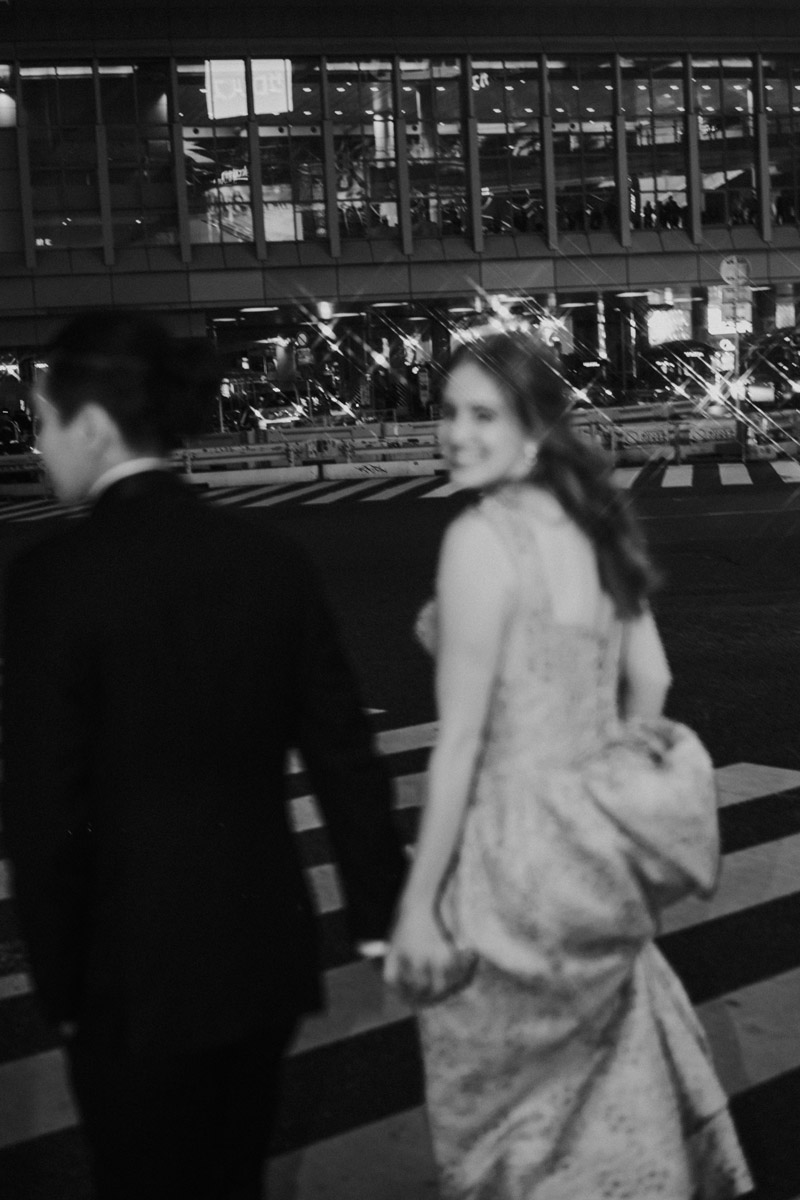
Nidhi and Surya also held a home solemnisation in Singapore in 2025, before the main wedding in Bangalore. This is an increasingly common structure for Singapore-based couples: a smaller, legally registered ceremony at home, typically with immediate family and closest friends, that allows the couple to be legally married in Singapore while keeping the main cultural celebration in India. The two ceremonies serve different emotional purposes, and the months between them can be a useful settling period before the larger event.
The Timeline Reality
Cross-border planning takes longer than local planning, because every decision that would normally be resolved in a quick site visit or an in-person vendor meeting becomes a video call, a WhatsApp exchange, and an email thread. Budget additional lead time, not just for bookings, but for the decision-making that precedes them.
Nidhi and Surya’s engagement ran for a year before the wedding. For a 700-guest wedding spanning two events in another country, that timeline gave them room to move at a considered pace rather than a reactive one. If your guest list is smaller or your events fewer, you may have more flexibility. But for a large South Indian wedding with multiple ceremonies, a year’s lead time is a reasonable floor, not a luxury.
Build in at least one dedicated trip to India for vendor visits, not just the venue, but the catering walk-through, the décor consultation if it is happening in person, and the ceremony rehearsal if your tradition includes one. The planning that happens in that trip will save you a significant amount of remote back-and-forth.

What Nidhi And Surya Would Tell You
Pick your battles, Surya says. You cannot make everything perfect while keeping everyone happy.
Do not feel too pressured to do what others are expecting you to do, Nidhi adds. Do what you want.
They would also tell you to prioritise family photos. At a wedding of 700 guests, with relatives arriving from across continents, those opportunities move faster than the day itself does.
The mechanics of planning a large South Indian wedding from Singapore are manageable. Many couples do it, and the vendor ecosystem on both sides of the distance has adapted to make it work. What requires more deliberate thought is the division of labour: knowing which decisions need local knowledge, which need someone in your time zone, and where the irreplaceable contributions of family fit into a vendor-managed operation. Get that architecture right, and the rest follows.
Nidhi and Surya’s full wedding feature, which includes the Haldi, the sparkler entrance, and the ceremony at Samaya, is on Wed&.
Vendor Credits
- Planning, florals, décor and stationery: We Plan For You / @weplanforyou.in
- Photography: Melvin Wong of Yet Another Boring Day / @yetanotherboringday
- Videography: Merry Go Hearts / @merrygohearts
- Venue: Samaya, Bangalore