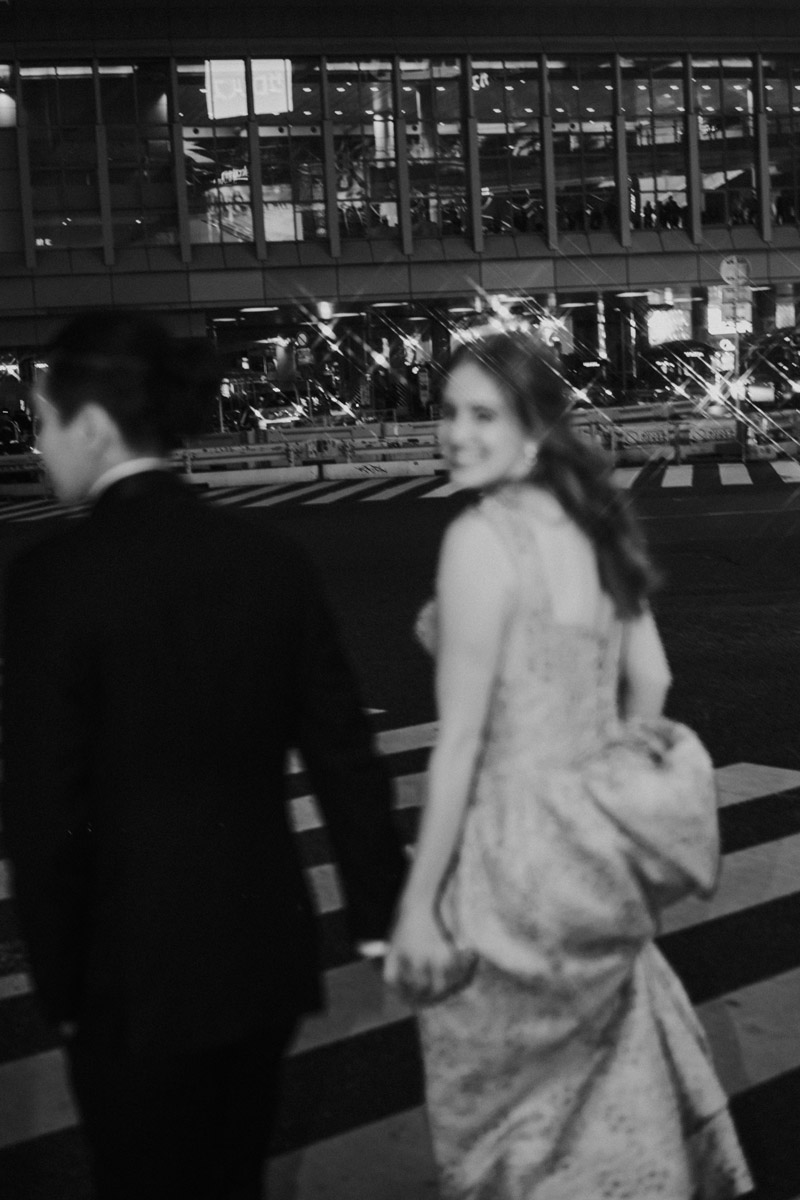
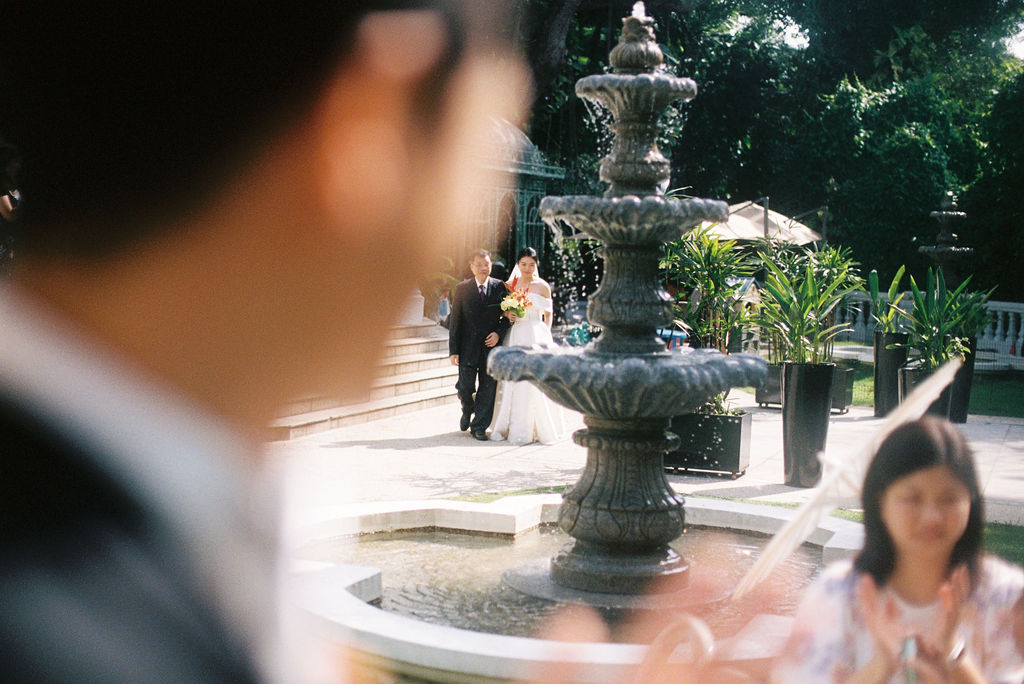
The Sangeet was meant to be the glamorous night, the more polished half of a two-day wedding. But what most guests will probably remember is the surprise. Nidhi and Surya had planned their walk-in through a tunnel of sparklers held up by their closest friends. It was the kind of entrance that covered everyone’s faces in warm orange light and crackled loudly enough that nobody could talk over it. What nobody knew, including the planning team, was that the couple were also going to break into a dance performance the moment they came through.
The venue was already doing a lot of the work. Samaya, just outside Bangalore, is a former betel-nut plantation with open grounds that don’t need much help from flowers or décor. The night air carried smoke from the kitchens (South Indian wedding food is famously generous and famously fragrant) and woodsmoke from the lighting setup. Terracotta tones glowed under soft uplighting. 700 guests, split roughly between family and friends who had flown in from different parts of the world, settled into a celebration that felt big without feeling overdone. The next morning would be the South Indian ceremony itself. But that night, the sparklers were enough.

How They Got Here
Nidhi and Surya met through mutual friends at a bar in Singapore. Surya was interested. Nidhi, by her own admission, was oblivious. They quickly realised they were from the same part of India and spoke the same language. That mattered more than it might sound, especially since both of them had ended up in Singapore through very different paths. Surya, who works as Head of Data Strategy, grew up in Oman. Nidhi, a consultant, comes from a family with roots in plantations and farmland back home.
Surya kept looking for an opening. It came, fittingly, through a small favour. He was visiting India and asked Nidhi if she wanted anything brought back. She asked for cake. That was the door he needed.
They describe their relationship in three words: goofy, familiar, safe. They also have what they call a ROT-DAY, a Saturday every couple of weeks where they do nothing, eat horribly, and just exist. It feels, by all evidence, like a relationship that doesn’t need to prove anything.
The proposal happened in 2025. Surya had taken Nidhi to Muscat as part of a Dubai trip for a friend’s wedding, partly because he wanted her to see where he had grown up. He proposed on a beach between mountains, under a moon that was just rising. They were engaged for a year before getting married in Bangalore.


Planning Around a Plantation
The venue came first, before any other vendor and before any design decisions. Both of them loved Samaya the moment they saw it. For Nidhi, it felt personal: her family’s connection to plantations and farms made the setting feel like home, not just a pretty backdrop. For both of them, the practical side was obvious too. It was outside the city, with wide-open skies, thoughtful landscaping, and enough space for 700 guests without the day feeling cramped.

That decision shaped almost everything else. Because the venue was already doing the heavy lifting, the brief to their vendors was simple: keep it restrained. The Sangeet leaned into terracotta tones and soft lighting instead of glitz. It felt understated, elegant, and warm. The morning ceremony stayed close to traditional South Indian style, with muted colours and florals, and let the plantation setting do the rest. Their planner, We Plan For You (@weplanforyou.in), also handled florals, décor, and stationery, which helped everything feel visually consistent across both events.


But a South Indian wedding of this size doesn’t run on a planner alone. Nidhi and Surya say what they really had was a planner plus an army of family members: relatives who knew the customs, knew the families, and naturally stepped in to help things run. It’s the kind of setup that makes sense for a 700-guest wedding over two days, where family knowledge matters just as much as a detailed schedule.
When it came to budget, they were clear about where to spend. Food was the splurge. It’s one of the main KPIs at an Indian wedding, Surya notes (only half-joking), because it’s what people remember. The caterer cost more than they had first planned. They still felt it was worth it.
Moments That Held
The Haldi happened on the morning of the Sangeet. It was meant to be the smallest event of the wedding, with only close family and friends, and somehow it became both of their favourite part. There were water guns, turmeric paste, and a relaxed energy that didn’t try too hard to be serious. “If I could relive one moment,” Nidhi said afterwards, “it would be the Haldi in general. That was my favourite event.” Surya’s answer was more specific: seeing Nidhi for the first time on the Haldi morning, after seven days apart in the lead-up to the wedding.


The Sangeet walk-in came that evening. The sparkler tunnel was planned. The dance was not, at least not from the guests’ point of view. Melvin of Yet Another Boring Day (@yetanotherboringday), who shot the wedding alongside Merry Go Hearts (@merrygohearts) on video, later described the two days in one word: chaos. He meant it kindly. As an introvert shooting his first Indian wedding, he said he had to take intentional pauses on day two just to reset. “The need to learn and be on my toes,” he said, “was exhilarating.”


The South Indian ceremony the next morning was the longest and most traditional part of the wedding. There were small modern touches woven into a format both families knew well. 700 people, a 700-person amount of food, and a ceremony that moved on its own timing rather than a Western-style schedule. By the end of it, both Nidhi and Surya admit they remember less of the day than they expected to. “We saw people, heard people, felt, tasted, and smelled smoke the whole time,” Nidhi says, a perfect description of any large South Indian wedding, delivered in the wonderfully understated way she seems to say most things.


What Made It Theirs
Almost everything about the structure was traditional South Indian, with the kind of small modern changes couples often bring: touches that felt personal without trying to rewrite the format. The decision not to over-decorate was intentional. So was the decision to host the wedding outside Bangalore, on land that meant something to one of them. So was keeping the Haldi small.
Nidhi and Surya had also held a home solemnisation in Singapore earlier in 2025, with Melvin photographing the event as well. It was a quieter, paperwork-and-legal version of getting married before the larger celebration in India. It’s a structure that more and more Singapore-based couples are using when their main wedding takes place overseas. 2 ceremonies, 2 registers, 1 relationship.
What They’d Tell Other Couples
“Pick your battles,” Surya says. “You can’t make everything perfect while keeping everyone happy.”
“Don’t feel too pressured to do what others are expecting you to do,” Nidhi adds. “Do what you want.”
The one thing they would do differently is make family photos a bigger priority. At a wedding this size, with relatives flying in from across continents, those photo moments disappear faster than anyone realises while the day is actually happening.
It’s the kind of advice that sounds simple, but usually isn’t. 700 guests, 2 events, a former betel-nut plantation, a sparkler tunnel, an unannounced dance, and a Haldi morning that ended up mattering more than the headline event. Nidhi and Surya planned a wedding that took the form seriously without taking itself too seriously. More than any one decorative detail, that is what made the two days feel like theirs.

Vendor Credits
- Planning, florals, décor and stationery: We Plan For You (@weplanforyou.in)
- Photography: Melvin Wong of Yet Another Boring Day (@yetanotherboringday)
- Videography: Merry Go Hearts (@merrygohearts)